Miyawaki Canopy Afforestation
By adapting Japanese botanist Dr. Akira Miyawaki's pioneer afforestation methods for residential boundaries, we construct fully functional native climax forests in spaces as small as 1,000 square feet.
The Science of High-Density Canopy Acceleration
Conventional landscape arboriculture spaces ornamental saplings 15 to 20 feet apart on manicured lawns. In this sparse arrangement, saplings invest immense metabolic energy into lateral branch spread and defense against wind shear, drying winds, and solar radiation.
In a Miyawaki pocket grove, native seedlings representing four distinct ecological canopy tiers are planted at dense intervals of 30 to 40 plants per 100 square feet. This close proximity triggers phytosociological competition for sunlight: seedlings surge vertically at 3 to 10 times standard nursery growth rates.
Within three years, the interlocking crowns create an unbroken forest canopy that shades out weeds, retains 100% of soil moisture, and drops ambient summer microclimate temperatures by up to 15 degrees Fahrenheit.
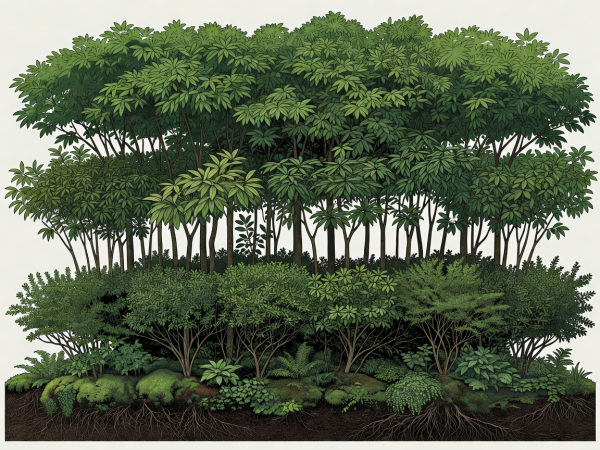
The Four Vertical Canopy Strata
Every pocket forest module engineered by Scoutclovercanvs balances these exact ecological layers:
Urban Microclimate & Acoustic Attenuation
Beyond water and carbon advantages, a 15-foot-deep Miyawaki belt planted along an estate road boundary absorbs up to 10 decibels of traffic sound and captures 80% of airborne PM2.5 and PM10 diesel particulates before they cross your living perimeter.